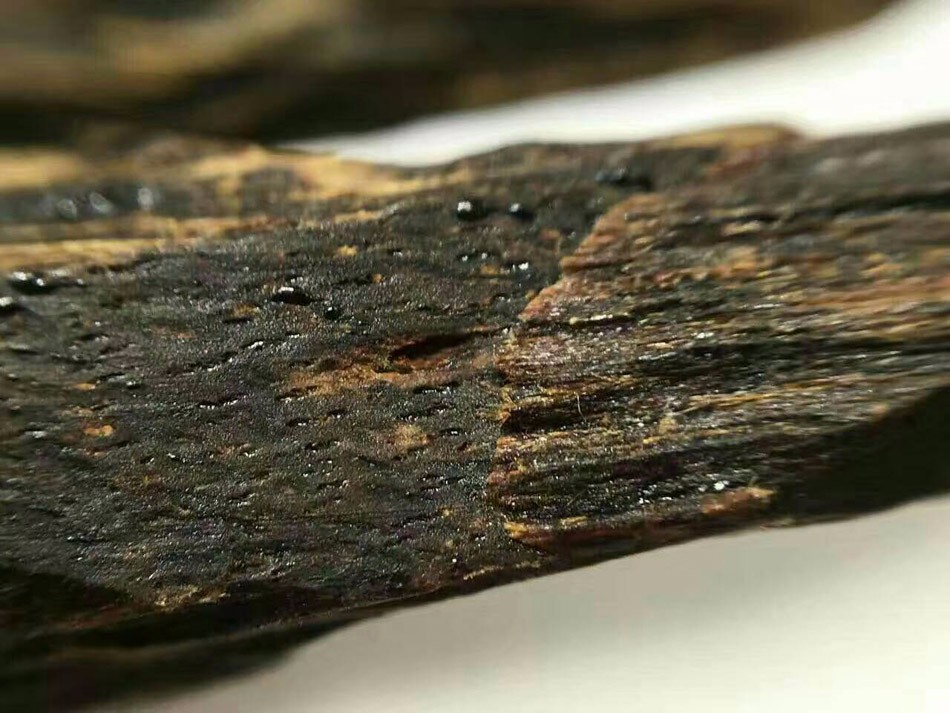
The most storied base note in perfumery. Agarwood is not a wood a tree simply grows — it is a resin the tree lays down to defend itself, and only a fraction of trees ever make it. The result, oud, is among the most valuable natural materials on earth.
Agarwood — agar in Hindi, sanchi/sasi in Assamese, oud hindi to the Arab perfume trade — is the dark, fragrant, resin-soaked heartwood of trees in the genus Aquilaria. Healthy Aquilaria wood is pale, light and almost odourless. Agarwood only appears when the tree is wounded and colonised by fungi and microbes; in defence, it floods the injured wood with an aromatic oleoresin.
That resin is so dense the best grades sink in water — the origin of the Japanese name jinkoh, “the wood that sinks.” Because formation depends on injury and infection, only a small fraction of wild trees ever carry usable agarwood, which is why both the wood and its distilled oil command extraordinary prices.
For a house built in the Eastern Himalaya, agarwood is not exotic — it is local. Northeast India, including Tripura, sits inside the native range of Aquilaria malaccensis and is today one of the largest cultivated agarwood belts in the world.
Agarwood is a base note in the truest sense — slow, heavy and enormously tenacious, a natural fixative that anchors a composition and unfolds for hours. Perfumers reach for it in amber bases, woody accords, chypres and fougères, and across the whole of modern “oud” fine fragrance.
The character is complex and unmistakable: a precious woody heart wrapped in sweet warmth, smoky incense and honeyed tobacco, shot through with animalic notes that read like musk or castoreum. The drydown turns sweeter and muskier still.
precious, resinous, dense
sweet, warm, honeyed
incense, ambery, tobacco
musky, castoreum, leathery
Agarwood’s chemistry is built on two classes of molecule. Sesquiterpenes make up the volatile, aromatic fraction you smell first — a dense thicket of agarofurans, agarospiranes, eudesmanes, eremophilanes and guaianes. 2-(2-phenylethyl)chromones (PECs) are heavier, low-volatility molecules that give agar its depth, its tenacity and much of its traditional pharmacology. Their co-occurrence is effectively a chemical signature of agarwood.
One caution before the numbers: agar is not a fixed material. Composition swings dramatically with species, resin grade, the individual tree, how the resin was induced, and the extraction method. Treat any single profile as a snapshot of one sample — never a universal standard. Expand the panels below for the detail.
| Compound | Class | Note / role |
|---|---|---|
| α- / β-Agarofuran, dihydro-β-agarofuran | Agarofuran | Warm woody; characteristic agar markers |
| Agarospirol | Agarospirane | Woody; a key indicator of genuine agar oil |
| Jinkohol, jinkoh-eremol | Sesquiterpene alcohol | Sweet-woody; named for jinkoh |
| Kusunol (valerianol) | Eudesmane | Woody-balsamic |
| Dihydrokaranone, karanone | Eremophilane | Deep woody ketones |
| Baimuxinol, isobaimuxinol, baimuxinal | Agarospirane | Woody; common in cultivated agar |
| β-Eudesmol, 10-epi-γ-eudesmol | Eudesmane | Woody alcohols |
| Selina-3,11-dien-9-one | Eudesmane ketone | Characteristic agar ketone |
| α-Guaiene, α-bulnesene, kessane | Guaiane | Green-spicy woody; often abundant |
| Valencene, α- / β-selinene | Selinane | Woody hydrocarbons |
Compound set compiled from published reviews of agarwood chemistry across the main Aquilaria species [1][2][6]. Relative abundances vary by sample; this is a qualitative map of what a GC-MS trace of agar oil typically contains.
| Compound | Class | Note / role |
|---|---|---|
| 2-(2-Phenylethyl)chromone (PEC) | Chromone (parent) | The core agarwood chromone scaffold |
| 6-Methoxy- / 6-hydroxy-2-(2-phenylethyl)chromones | Chromone | Oxygenated PECs; heavy, tenacious base |
| Crassin A–D, aquilacrassin A–F (species-specific) | Chromone | Markers described from specific species |
Chromones are semi- to non-volatile: they are abundant in the wood itself, in CO₂ extracts and in aged or heated material, and contribute far less to a light steam distillate. In one broad characterisation, chromones made up the majority of constituents (~57%) versus sesquiterpenes (~35%) [2] — a reminder that “agarwood oil” and “agarwood smoke/extract” are chemically different things.
| Compound | Class | Approx. |
|---|---|---|
| Kessane | Guaiane (oxygenated) | ~29% |
| α-Guaiene | Guaiane | ~25% |
| β-Dihydroagarofuran | Agarofuran | ~11% |
| β-Selinene, caryophyllene oxide, α-muurolene, epoxy-bulnesene | Sesquiterpenes | <1% each |
Illustrative only — headspace SPME (DVB/CAR/PDMS) of one A. malaccensis sample, in which 70–100+ compounds were detected [6]. A different tree, grade or a true distilled oil would look markedly different. This is exactly why every serious buyer asks for a batch-specific GC-MS.
The profiles above map agarwood chemistry across the genus, drawn from the published literature. They are a guide to the material — not a substitute for a specification.
The numbers that matter to a formulator are the ones printed on the batch in front of them. Every lot we release is characterised on our own cultivated Tripura material and ships with its chromatogram attached.
Agarwood forms through a stress response. When an Aquilaria tree is injured — by storm, insect, animal or blade — and the wound is invaded by fungi such as Phaeoacremonium and Fusarium species, the tree deposits fragrant oleoresin around the site to seal and defend itself. Over months to years, that resin accumulates and darkens the wood into agar.
In the wild this is rare and unpredictable, which drove centuries of destructive over-harvesting. Modern cultivation instead grows Aquilaria as a plantation crop and induces resin deliberately, which is both the sustainable path and the legal one for trade — the subject of the status section below.
Aquilaria is a genus of evergreen tropical trees, 20–40 m tall, in the family Thymelaeaceae, with roughly 21 accepted species spread from India and Bangladesh across Southeast Asia to Borneo and the Philippines. Four species supply most commercial agarwood: A. malaccensis, A. sinensis, A. crassna and A. subintegra.
India is home to two. Aquilaria malaccensis — the classic “oud hindi” tree — is the widespread species and the one cultivated across the Northeast. Aquilaria khasiana is endemic to the Meghalaya hills and critically endangered, with only a handful of wild individuals recorded — a reminder that the genus carries both commercial promise and real conservation weight.
Agarwood has been burned as sacred incense in Buddhist, Hindu and Muslim practice for millennia, and distilled into oud, one of perfumery’s crown ingredients. In traditional medicine it is equally established: as chen xiang in Chinese medicine and agaru in Ayurveda, it is used to regulate digestion, calm the mind, relieve pain and ease breathing, while the leaves are taken for constipation, high blood pressure and diabetes.
Modern pharmacological studies report anti-inflammatory, antioxidant, antimicrobial and sedative activities, much of it attributed to the chromone fraction. These are traditional and preclinical findings offered as botanical context — not medical advice or health claims.
Every species of Aquilaria is listed on CITES Appendix II, and A. malaccensis is Critically Endangered in the wild. This is not a footnote — it defines how the botanical can be worked. In India, the export quota for wild-harvested agarwood is zero; only cultivated material may be traded internationally, under permit.
That framework has recently opened up. In 2024, following a national non-detriment assessment, CITES raised India’s annual export quota to roughly 151,080 kg of agarwood chips and powder and 7,050 kg of oil — up from 25,000 kg and 1,500 kg — recognising an estimated 139.89 million cultivated Aquilaria trees across Assam, Manipur, Nagaland and Tripura. Assam has since begun the first legal chip exports to the Gulf.
For Raima this is the whole point: agarwood here is a legitimate, cultivated, Northeast-Indian crop with a real and widening export path — provided it is grown, inducted and papered correctly. Any agarwood we pursue will be cultivated, permit-backed and GC-MS documented. Nothing wild, nothing grey.