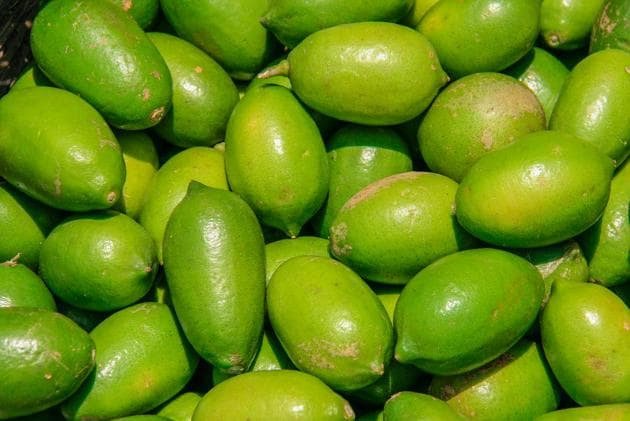
A semi-wild aromatic lime of the India–Bangladesh hill country, prized for a rind and leaf so fragrant they can carry a room. Grown for perfume, not pulp — and the first of its kind to be distilled and documented at origin.
The gondhoraj lebu — gondho-raj, literally “king of fragrance” — is a green, thick-skinned aromatic lime of Bengal and the surrounding hill country. Bengalis rank it above the ordinary lime the way a wine grower ranks a cru above a table grape: it is not simply sour, it is perfumed, with a scent potent enough to fill a kitchen from a single zested fruit.
What makes it valuable to an aroma house is exactly what its name promises. The fruit is prized for its intensely fragrant rind and its kaffir-like aromatic leaf far more than for its modest juice. That puts its worth in the volatile oils of peel and leaf — the two things a distiller can actually capture.
It is a botanical that has been hiding in plain sight: beloved in the kitchen, celebrated in craft gin, and never properly distilled and characterised at origin. That is the work we were built to do, and this is our signature botanical.
Where agarwood is a base note, gondhoraj is a top note — fresh, sharp and diffusive, the kind of brightness that lifts and opens a composition. The signature is a sparkling green lime zest laid over kaffir-leaf and lemongrass facets, with a cool, quiet floral bloom running underneath that sets it apart from an ordinary lime.
It is a natural fit for citrus and cologne structures, gin and beverage flavour, and any brief that wants a living, green citrus rather than a flat “lemon.” Like all citrus top notes its beauty is fleeting, which is exactly why we distil within hours of harvest rather than days.
sparkling, sharply green, citric
kaffir-adjacent, tea-green
a cool, quiet floral trail
lemongrass, fresh, lifting
A citrus like the gondhoraj yields two quite distinct materials. The cold-pressed peel oil is dominated by the monoterpene limonene, carried by β-pinene, γ-terpinene and sabinene, with small but aroma-defining amounts of the lemony aldehyde citral (neral + geranial) and sweet esters. The leaf (petitgrain) oil tells a different story: far less limonene, and much more citronellal, citronellol and linalool — the same aldehyde-and-alcohol register that gives kaffir-lime leaf its character, which fits the gondhoraj’s famously aromatic foliage.
No published GC-MS of gondhoraj oil distilled at origin exists. We are generating the first. The tables below are reference profiles from closely related citrus peel and leaf oils, shown so you can read the chemical shape — the gondhoraj numbers will be ours.
| Compound | Class | Typical |
|---|---|---|
| Limonene | Monoterpene | ~48–95% |
| β-Pinene | Monoterpene | up to ~15% |
| γ-Terpinene | Monoterpene | variable |
| Sabinene | Monoterpene | minor |
| Citral (neral + geranial) | Aldehyde | minor · key odour |
| Neryl & geranyl acetate | Ester | trace–minor |
| β-Caryophyllene | Sesquiterpene | trace |
Reference ranges for lemon/lime cold-pressed peel oils [4]. Limonene sets the fresh citrus body; the small citral fraction carries much of the recognisable “lemon-lime” signal. Phytochemicals specifically reported for gondhoraj — β-pinene, limonene and β-caryophyllene — are consistent with this profile [2].
| Compound | Class | Note / role |
|---|---|---|
| Citronellal | Aldehyde | Signature kaffir/gondhoraj-leaf note; fresh, green, rosy |
| Citronellol | Alcohol | Soft, rosy citrus |
| Linalool | Alcohol | Floral, fresh |
| Sabinene | Monoterpene | Green-woody lift |
| Citral, nerol, geraniol | Aldehyde / alcohols | Lemony, floral facets |
| Limonene | Monoterpene | Present but lower than in peel |
Citrus leaf/petitgrain oils shift away from limonene toward citronellal, citronellol and linalool [4]; kaffir-lime leaf is the classic citronellal-rich reference for an aromatic-lime foliage of this kind. We measure the exact proportions for gondhoraj leaf on our own material, harvest window by harvest window.
The tables above are reference values from related citrus, labelled as such. They map the chemical territory — they are not a specification, and we would not pass off another fruit’s data as this one’s.
The absence of an origin GC-MS for a fruit this famous is a white space, and closing it is the founding work of this house: cold-press the peel, steam-distil the leaf, publish real chromatograms. Every lot ships with its own.
Everyone agrees the gondhoraj is a Citrus in the family Rutaceae. Past that, botanists disagree. It is most often tied to the Rangpur / Citrus × limonia group — a mandarin-and-lime hybrid lineage — while its intensely aromatic leaf reads as kaffir-adjacent (Citrus × hystrix), and at least one source files it under Citrus macroptera, a classification we reject: that name belongs to the satkora used in Sylheti beef curries, a different fruit entirely.
Resolving that question is part of the work. A documented chemical fingerprint, and in time genetic characterisation, is what turns a beloved regional fruit into a material a formulator can specify — and it is one of the reasons this house exists rather than simply trading what already moves.
The gondhoraj is valued first and foremost for its fragrant rind and leaf, with a modest but intensely aromatic juice used liberally across Bengali cooking and drinks. It is not a juiceless fruit, and it is not a juice crop — its worth sits in the peel and the foliage, which is exactly where we work.
In the kitchen the gondhoraj is a Bengali and Bangladeshi essential — its zest and leaf lift dal, fish, meat, chutneys and street food, and its juice defines drinks from gondhoraj ghol to modern cocktails. The craft-drinks world has taken note too: this aromatic-lime type is the lineage behind Rangpur-style gins.
Beyond flavour, it carries the usual citrus virtues — a good dose of vitamin C and the antioxidant and antimicrobial activity typical of citrus peel oils — and it appears in skin and wellness formulations for its fragrance and freshness. Our work moves it from the kitchen into fine fragrance and premium flavour as a documented, single-origin material.
The gondhoraj’s heartland is the hill country where India meets Bangladesh — Sylhet and the Chittagong hills, across Bengal, and into the Northeast Indian tracts that include Tripura. It grows poorly when taken far from this belt, which is part of the romance and, more usefully, part of the moat: a genuinely regional botanical is hard for a distant competitor to replicate.
So we extract it where it already belongs. We cultivate for oil, harvest in season, and distil peel and leaf within hours — turning a beloved local fruit into the first properly documented gondhoraj aroma material. Each lot is traceable to its grove and its harvest window, and this monograph carries those numbers as they are made.